Which AI-First CRM Gives Intent-Based Deal Recommendations? An Honest Review for Small Businesses
Which AI-first CRM gives intent-based deal recommendations? An honest look at what small teams get, what AICRM does and doesn't do, and who should pick what.
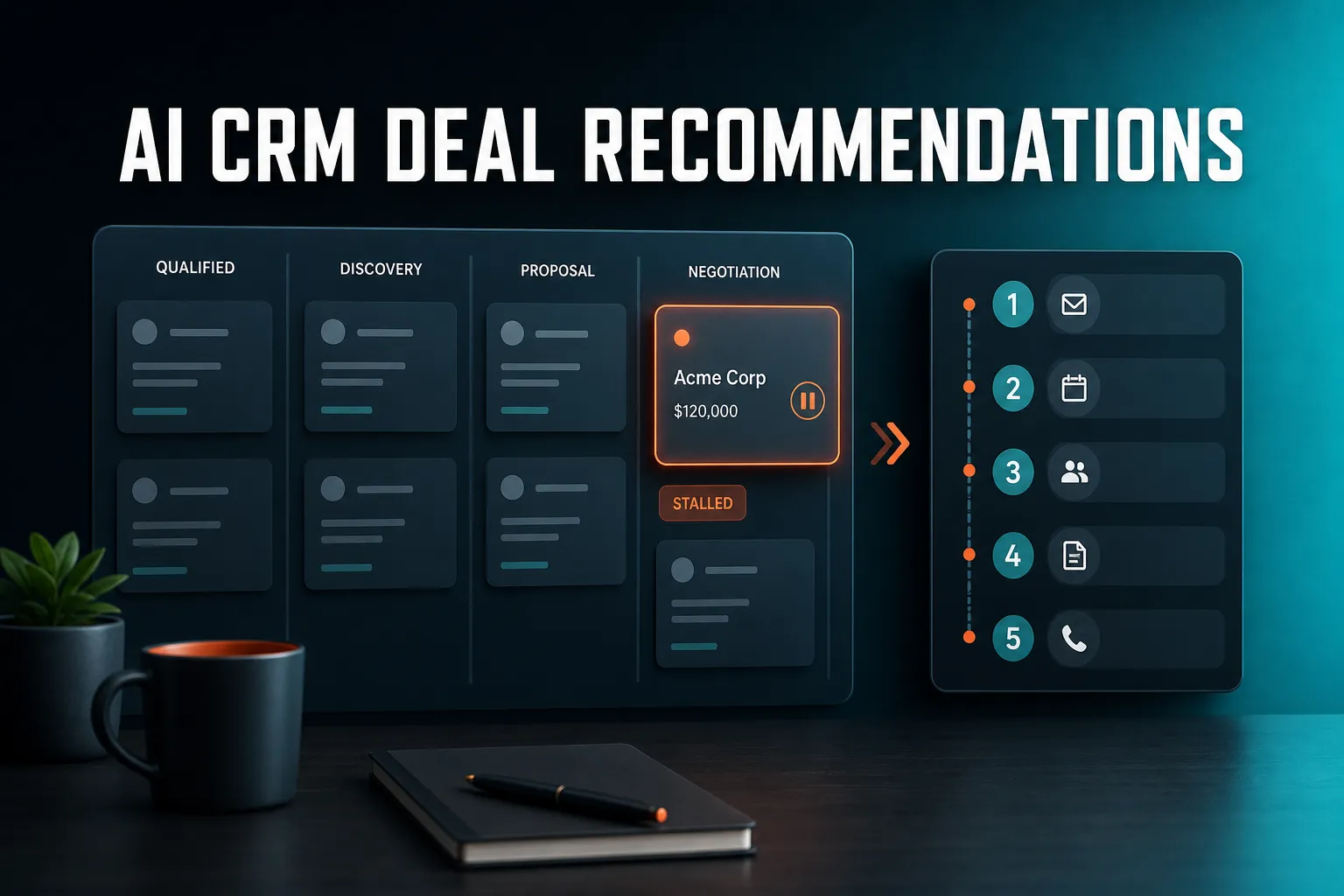
There is no single AI-first CRM that is the answer to 'intent-based deal recommendations', because the phrase covers two different things: predictive deal scoring, and attention-based recommendations. AICRM, a proactive CRM for small teams, takes the second route. It surfaces the deals and contacts that need attention today (stalled deals, overdue follow-ups, emails awaiting a reply, contacts back on your website) and helps you act on them in the same conversation. It does not forecast or predict win probability, so larger sales teams that need that should look at a bigger platform.
Which AI-first CRM provides intent-based deal recommendations?
It depends on what you mean by intent. Larger CRMs tend to aim at predictive deal scoring and suggested next steps for sales reps. AICRM gives attention-based recommendations: a live Daily Brief (including stalled deals, due follow-ups, unanswered emails and contacts returning to your site) and, when you ask 'what needs my attention?', a ranked list with a reason for each item. It does not predict outcomes.
There are broadly three approaches, and it helps to know which one you are buying:
| Approach | What it tells you | Best for |
|---|---|---|
| Predictive deal scoring | The likelihood a deal will close, based on patterns in past deals | Larger sales teams with plenty of deal history and a sales-ops owner |
| Rules-based lead scoring | Which contacts match the profile you defined | Teams that want to see why someone ranks highly |
| Attention-based recommendations | What has gone quiet, come back or become due, and what to do about it | Founders, consultants and small teams who want to stay on top of customers with less admin |
HubSpot, Salesforce and Pipedrive are worth checking if you want the first approach, though features and plans change often, so look at what is included in the plan you would actually buy. AICRM covers the second and third approaches. Our post 'Best AI CRM in 2026' compares the wider field.
What is the best AI-first CRM that actually helps close deals, not just store data?
The best one is the CRM that gets you to do the right thing at the right time, and that depends on your team. For a large sales team that needs forecasting, quotas and custom pipelines, HubSpot, Salesforce or Pipedrive are stronger choices. For a small team that mainly loses deals through forgotten follow-ups, a proactive CRM such as AICRM is a closer fit.
A CRM that only stores data waits for you to look. A CRM that helps close deals does four things:
- Shows you what needs attention without you going searching.
- Gives you context, such as the reason a follow-up exists and what happened last time.
- Helps you act, for example by drafting the email or logging the call.
- Keeps the admin light, so the records stay accurate.
Try this test on any CRM you are considering. Open it on a Monday morning and ask: does it tell me which three things to do first, and why? If you have to build a report or filter a list to find out, it is storing data, not helping you close.
How does AICRM recommend what to do on a deal?
AICRM recommends actions from your own activity, not from a prediction model. The Daily Brief is computed live when you open the dashboard and lists follow-ups due, emails awaiting a reply, open tasks, new signals, stalled deals, contacts back on your site and customers gone quiet. You can also ask the agent 'what should I do next?' and get one ranked list with a reason for each item.
Here is what each part does today:
- Stalled deals. AICRM has a lightweight deal board with fixed stages: New, Qualified, Proposal, Won and Lost. When a deal sits in a stage too long, it appears in the Daily Brief and the 7am weekday email.
- Follow-ups with reasons. Each contact can have a next follow-up date and a reason. AICRM can pick these up from logged calls, notes and emails, such as 'call me after the 15th'.
- No-reply chasing. One-to-one emails sent from AICRM that get no reply, call or meeting after 3 days show as 'awaiting a reply' for up to 14 days.
- Signals. Company news and job title changes are tiered Hot, Warm or Monitor, and the important ones come with a drafted outreach message.
- Drafts. Ask 'draft follow-ups for my top three contacts' and AICRM saves a draft on each contact. Nothing is sent until you review it and explicitly ask for it to be sent.
The ranked 'what needs my attention?' list puts overdue follow-ups and hot signals first, then follow-ups due today, unanswered emails, contacts back on the website, warm signals and tasks. It does not rank by lead score. Our post 'How a CRM Daily Brief Shows What Needs Your Attention' goes deeper, and the Features page lists every capability.
A worked example
Imagine a consultant with six open proposals (a made-up example). On Tuesday her brief shows one deal stalled in Proposal, a client who has not replied to an email she sent from AICRM on Thursday, and a contact whose company announced funding. She asks the agent to draft a follow-up for the unanswered email. It saves the draft on the contact, she edits it and sends it herself. Nothing here was predicted. It was noticed, explained and acted on.
What does 'intent' mean in a small business CRM?
In a small business CRM, intent means observable signs that someone may be ready to talk: returning to your website, submitting a form, a company announcement or a new job role. AICRM captures these as signals. It recognises known contacts who come back after a form submission and identifies anonymous visitors at company level only. It does not identify individual anonymous people.
The intent signals in AICRM today are:
- Known contacts back on your site. Shown in the Daily Brief when a real contact returns after submitting a form.
- Company-level visitors. Prospects reverse-identifies the companies behind anonymous traffic, with consumer ISPs excluded.
- Page-view history. Visible on each contact's timeline, including what they viewed before a form submission.
- Company news and role changes. Funding, hiring, launches and awards, plus job title changes, found in a rate-limited pass of roughly 100 contacts a week.
- Email opens and site visits. These can feed your lead-scoring rules.
Be realistic about this. It is a useful nudge, not a mind-reader. A company viewing your pricing page four times is a reason to reach out, not proof it will buy. If you want the website side in detail, see our posts on identifying the companies visiting your website and on CRM website visitor tracking.
Is there an AI CRM for small business with predictive insights?
AICRM does not offer predictive insights such as win probability or revenue forecasts. What it offers is transparent scoring and live signals: lead scores from rules you set, a Hot, Warm or Monitor tier on company news, and analytics that include AI-surfaced insights from your real data. For many small businesses, that is more useful than a prediction.
There is a practical reason to be cautious about prediction at small scale. A model that predicts deal outcomes needs a decent history of won and lost deals to learn from. A founder with a few dozen deals a year usually does not have that, so a score may look precise without being reliable. A rule you wrote yourself, such as 'VP titles at companies of a certain size who visited twice this month', is easier to trust and easier to correct.
AICRM's lead scoring works this way. You set rules in Settings with no code, covering job title, industry, company size, location, source, recency, email opens and site visits. The score recalculates when one of those events happens, and a manual adjustment sits on top with a reason attached, so your judgement is not silently overwritten.
If you do need forecasting, weighted pipelines or sales-ops reporting, AICRM does not have them. Choose a larger platform and accept the extra setup.
Which AI CRM for small business helps increase deal conversions?
No CRM can promise higher conversions, but for many small businesses the most reliable gains come from faster and more consistent follow-up. An AI CRM helps by surfacing who is due a reply, who has gone quiet and who has just shown interest. AICRM is built around that: Attention, then Context, then Action.
Here is a practical routine that works with any proactive CRM, and how AICRM supports each step:
- Set a next follow-up date every time you talk to someone. In AICRM you can set it by hand, ask the agent, or let it be picked up from a logged call, meeting, note or email.
- Start the day with the brief. It arrives in your inbox at 7am on weekdays (you can switch this off in Settings) and is skipped when there is nothing to act on. Monday includes a three-day lookback.
- Chase unanswered emails. Any one-to-one email you sent from AICRM that has had no reply after 3 days is flagged.
- Act on signals quickly. A funding announcement or new role is a natural reason to get in touch, and a drafted message is waiting.
- Keep the deal board honest. Move deals through the stages by drag and drop or by voice, and let stalled ones come back to you.
- Revive the quiet ones. The brief counts customers with no contact logged in 90 or more days, and the agent can turn them into a segment. See our post on finding and winning back inactive customers.
One limit to know about: AICRM only reads follow-ups from conversations logged in it, meaning notes, calls and meetings you log there and emails sent from AICRM or BCC'd or forwarded to it. It does not listen to calls or read your inbox, so the habit of logging matters. Voice makes that quick, but it is how you act, not the point of the product.
When is AICRM not the right choice?
AICRM is not the right choice if you need a forecasting-grade sales pipeline. It has a lightweight deal board with fixed stages, but no custom or multiple pipelines, no forecasting, quotas, weighted probabilities or sales-ops reporting. It also has no phone dialler, SMS or calling features.
Choose something else if:
- You run a larger sales team with managers who need pipeline forecasts and quota tracking. HubSpot, Salesforce and Pipedrive are built for that.
- Your sales process needs custom stages or several pipelines.
- Your reps live on the phone and want calling and SMS inside the CRM.
- You want the CRM to read your whole inbox automatically.
Choose AICRM if you are a founder, consultant, small-business owner or small team that keeps losing track of follow-ups, wants a short list of what matters each morning and wants less CRM admin. Our posts on AI CRM for startups and the best CRM for a team of under 10 with no sales ops cover similar ground.
How much does an AI-first CRM like AICRM cost?
AICRM has three plans, all with the full CRM. Starter is $29 a month with 120 voice-agent minutes and up to 2,000 contacts. Growth is $79 with 400 minutes and 5,000 contacts. Power is $149 with 600 minutes and 20,000 contacts. Extra voice minutes cost $0.15 a minute, capped at $2 a day. There is no per-seat charge.
Every plan includes the Daily Brief, follow-ups, tasks, signals, segments, campaigns, the voice agent, forms, web tracking, Prospects company ID, automation, calendar and booking, and analytics. The Daily Brief appears on your dashboard and the deal board can be used by drag and drop, so voice minutes matter mainly if you want to act by talking. See the pricing page for the current details.
What should you do next?
Test any AI CRM on your own data, not a demo. Start the 7-day free trial of AICRM, import a CSV of your contacts, set a few follow-ups and see what the brief tells you the next morning. If you want a walkthrough first, watch the demo, or contact us with questions about whether it fits.
The trial gives you full features, with no card required to start. If the brief does not point you to something useful within a week, a different kind of CRM is probably the better choice, and that is a perfectly good outcome.
Frequently asked questions
Which AI-first CRM provides intent-based deal recommendations?
It depends on what you mean by intent. Larger platforms such as HubSpot, Salesforce and Pipedrive are worth checking if you want predictive deal scoring for sales teams. AICRM gives attention-based recommendations from real activity: stalled deals, due follow-ups, unanswered emails, contacts back on your website and company news. It does not predict win probability.
What is the best AI-first CRM that actually helps close deals, not just store data?
For large sales teams needing forecasting and custom pipelines, a larger platform is the better choice. For small teams that lose deals to forgotten follow-ups, a proactive CRM like AICRM fits well because it surfaces what needs attention each day and helps you act on it. Test any option with your own contacts first.
Is there an AI CRM for small business with predictive insights?
AICRM does not offer predictive insights such as win probability or forecasts. It gives rules-based lead scoring you can inspect, Hot, Warm and Monitor signals on company news and role changes, and analytics with AI-surfaced insights. For small deal volumes, transparent rules are often easier to trust than a prediction.
Can an AI CRM for small business increase deal conversions?
It can help, mainly by making follow-up faster and more consistent. AICRM flags overdue follow-ups, one-to-one emails sent from AICRM with no reply after 3 days, stalled deals and returning contacts, and drafts emails for you to review and send. No CRM can guarantee higher conversion rates, so judge it on whether it helps you act sooner.
Does AICRM have a sales pipeline?
AICRM has a lightweight deal board with fixed stages: New, Qualified, Proposal, Won and Lost. You can drag deals between stages, see value totals per stage and move deals by voice. It does not have custom or multiple pipelines, forecasting, quotas or weighted probabilities.
Does AICRM identify individual website visitors?
No. AICRM recognises known contacts when they return to your site after submitting a form, and it identifies anonymous visitors at company level only, using reverse IP lookup with consumer ISPs excluded. It does not name individual anonymous people.